
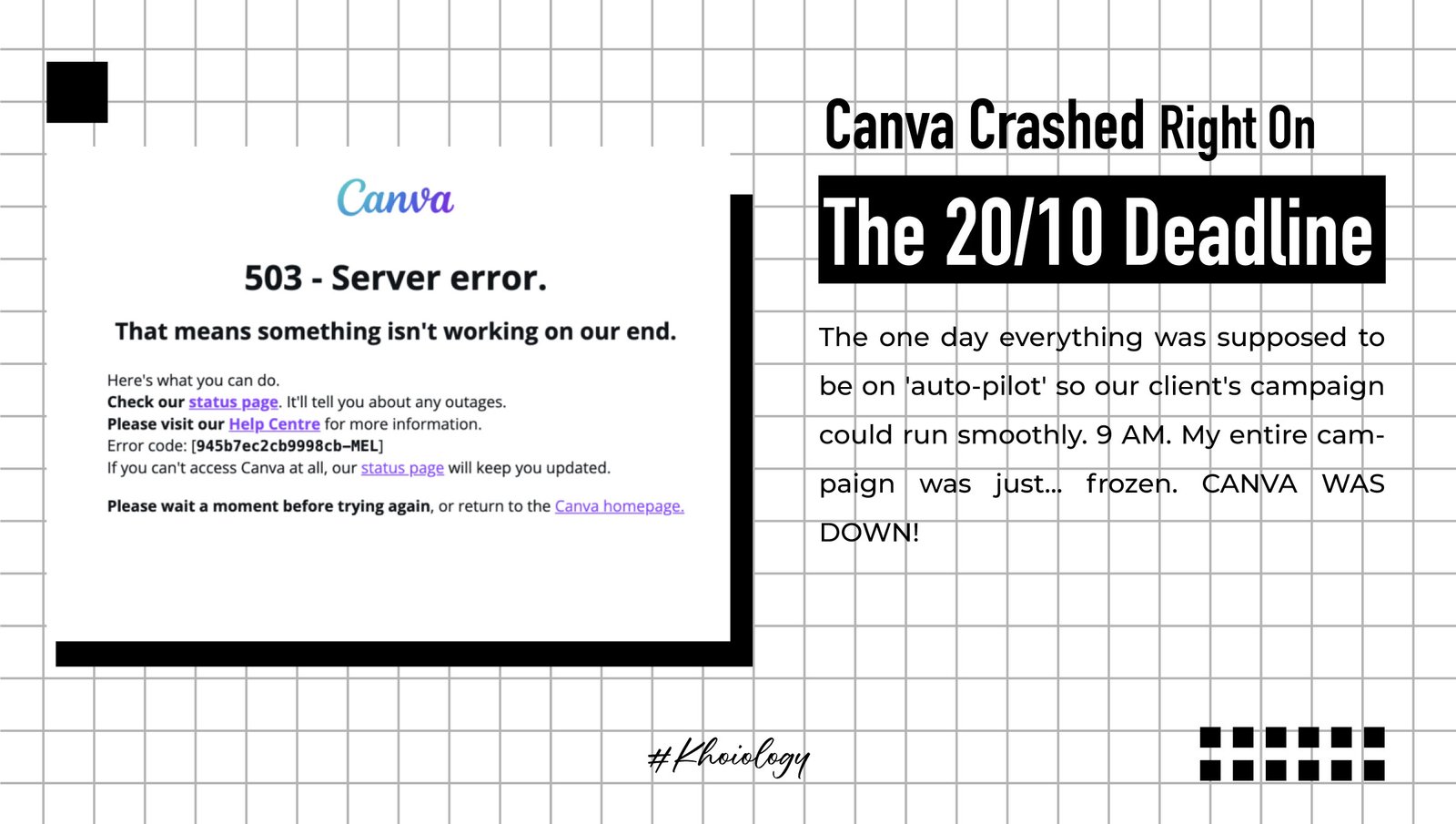
The Morning the Marketing Industry “Froze”
The morning of October 20th. As a marketing professional with over 10 years in the field—both as a lecturer and an agency CEO—I believe this was one of the most “memorable” mornings for the entire Vietnamese marketing industry.
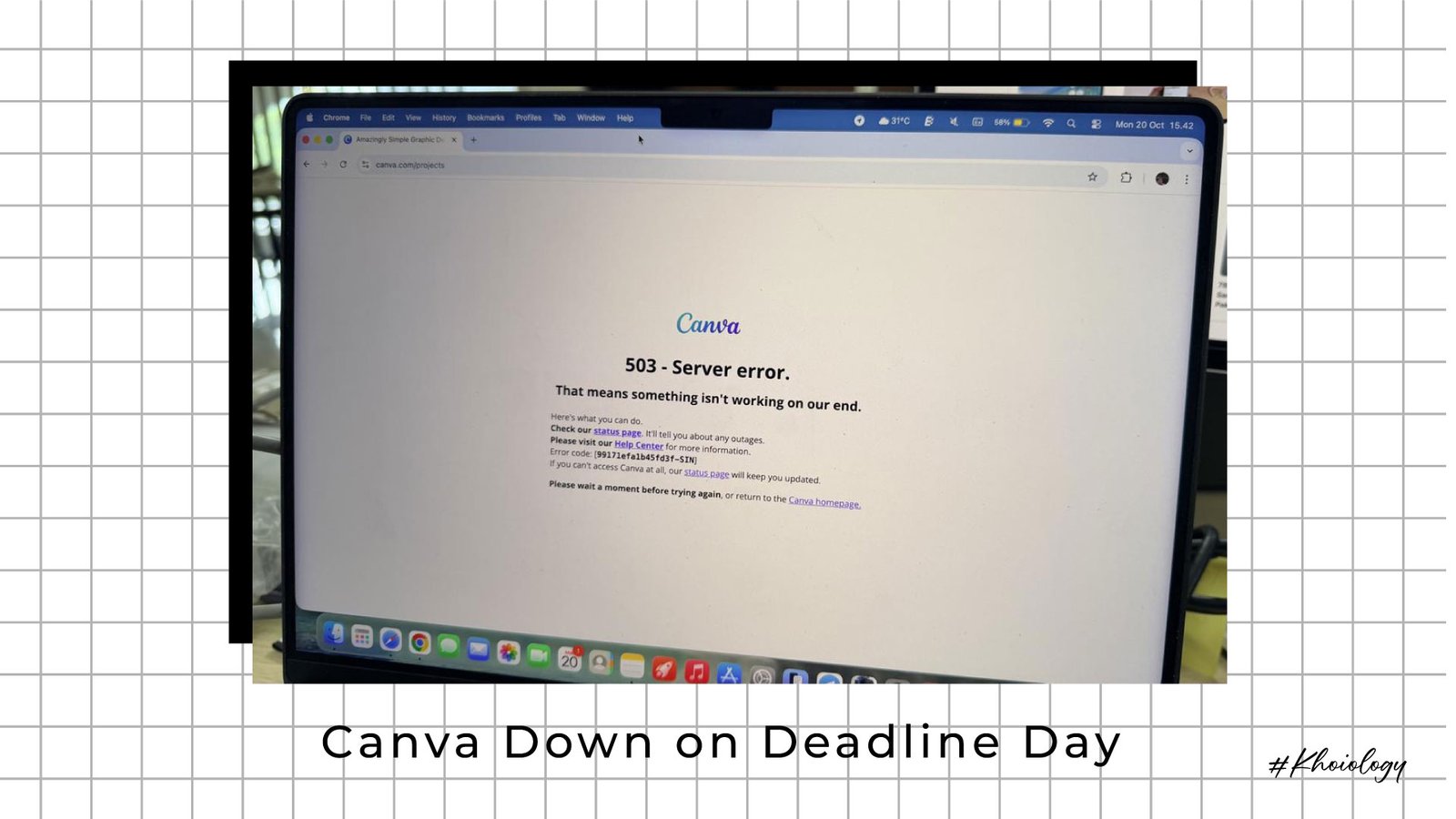
9:00 AM. Go-live day. Hundreds of 20/10 (Vietnamese Women’s Day) campaigns were armed and ready to launch. And then… Canva crashed.
It wasn’t just one person. It was THOUSANDS of Marketers, Designers, and Content Creators staring at loading screens, collectively “frozen.”
I scrolled through Zalo groups, Facebook groups… and everywhere, there was a palpable sense of panic. A barrage of questions exploded:
- “We’re down, what about you?”
- “All client files are stuck on the platform, what’s the solution?”
- “The deadline is breathing down my neck, please help me!”
It was a moment of collective anxiety. Everyone was desperately trying to find a fix. Clients started calling. Bosses started asking. Agency teams were sweating bullets.
Wait? We didn’t know for how long. Redo it in Photoshop/AI? Many have the tools but lack the advanced skills for a quick turnaround.
That feeling of helplessness, of not knowing how to react when your entire “arsenal” is locked away, is truly an unforgettable experience. It was a genuinely difficult day for the entire industry.
Expert Analysis: Why Did One Platform Outage Paralyze an Entire Industry?
This incident isn’t merely about a tool failing. It exposes a worrying, systemic truth about our industry: Our critical over-reliance on a single, convenient platform.
Canva is brilliant. It successfully “democratized” design, empowering anyone to create beautiful visuals. But that very convenience has created a critical point of failure.
When your entire workflow, all your client assets, and your team’s primary skill set are hosted “in the cloud” of a single third-party vendor, you have inadvertently handed them complete control over your operations. This outage was a harsh reminder of that reality.
From this collective “pain,” here are the three hard-earned lessons every marketer, agency, and brand must internalize.
Lesson 1: Don’t Put All Your Eggs in One Basket — Diversify Your Toolkit
This is the most obvious lesson. Canva is your primary tool, but it cannot be your only tool. Always be prepared with at least one or two alternatives. This could be Figma, Adobe Express, Crello, or even mastering the advanced design features of PowerPoint and Google Slides. When the main door is locked, you must know where the side window is.
Lesson 2: Beyond “Plan B” — Build Resilient Processes & Risk Management SOPs
Having a “Plan B” isn’t just about having another tool; it’s about having a “Process B.” As an agency CEO, I don’t just worry about tools; I worry about workflows.
- Implement a “Critical Asset Backup” SOP: This needs to be a non-negotiable company policy. Don’t just rely on Canva’s cloud. At the end of every day, or upon completing a major draft, final files (PNGs, PDFs) and, where possible, editable templates must be exported and backed up to a separate, secure location (e.g., Google Drive, OneDrive, or a local server/NAS). This creates redundancy.
- Establish a “Red Alert” Workflow: What happens when the primary tool fails? Your team must have a Standard Operating Procedure (SOP).
- Immediate Assessment: How long is the estimated downtime? (Check official status pages, not just social media).
- Triage: Which deadlines are critical (within 2-3 hours) vs. non-critical (next day)?
- Activate Contingency: For critical assets, the instruction cannot be “we wait.” It must be: “Rebuild immediately on Platform B (e.g., Adobe Express) using our pre-saved brand kits and templates.” This requires that those brand kits also exist on Platform B.
- Decouple Storage from Creation: The problem was that files were “stuck.” Your process should separate asset storage (logos, fonts, core images) from the design tool. All core assets should live in a central, accessible cloud drive, ready to be plugged into any tool, not just locked within Canva’s “Uploads” folder.
Lesson 3: Elevate Core Competency Over “Tool-Using” Ability
This is the most critical lesson, especially from my perspective as an educator. The panic revealed that many have become expert “tool operators” but not necessarily expert “design thinkers” or “visual communicators.”
A tool, even a great one like Canva, is just a hammer. Your core competency is being the architect and the carpenter.
- What is Core Competency?
- Strategic Thinking: Understanding the why behind the design. Who is the audience? What is the one key message? What is the call-to-action? A tool cannot answer this.
- Design Fundamentals: Knowing how to communicate visually, regardless of the tool. This is your knowledge of hierarchy, typography, color theory, contrast, and layout. A person with strong fundamentals can create a passable design in Microsoft Paint, while a person with none will create a mess in Photoshop.
- Problem-Solving: The ability to look at a locked-down Canva and say, “Okay, I can’t make that, but I can communicate the same message by grabbing our logo from the Drive, finding a stock photo, and laying out clean text in Google Slides. It will be 80% as good and 100% on time.”
- Train for “Tool Agnosticism”: As leaders and educators, we must train our people to be “tool agnostic.” Drill them on the fundamentals. Give them a brief and ask them to execute it in three different programs. The goal is to create professionals whose value is in their brain, not in their “Canva Pro” subscription.
Conclusion: A Necessary and Expensive Wake-Up Call
The morning of October 20th was a painful, expensive, and stressful day for our industry. But perhaps it was a necessary one.
The convenience of technology is a double-edged sword; it can lull us into a state of dependency. The Canva crash was a powerful, industry-wide wake-up call. It’s a stark reminder of the vital importance of risk management, process diversification, and, above all, investing in our own fundamental, non-Tool-dependent skills.
