
Have you ever felt like you were running at full speed without knowing where you were going? Or conversely, have you had a perfect plan in your mind but couldn’t lift a finger to start?
A friend once showed me three interesting “equations” about life that I believe every one of us has experienced at least once:
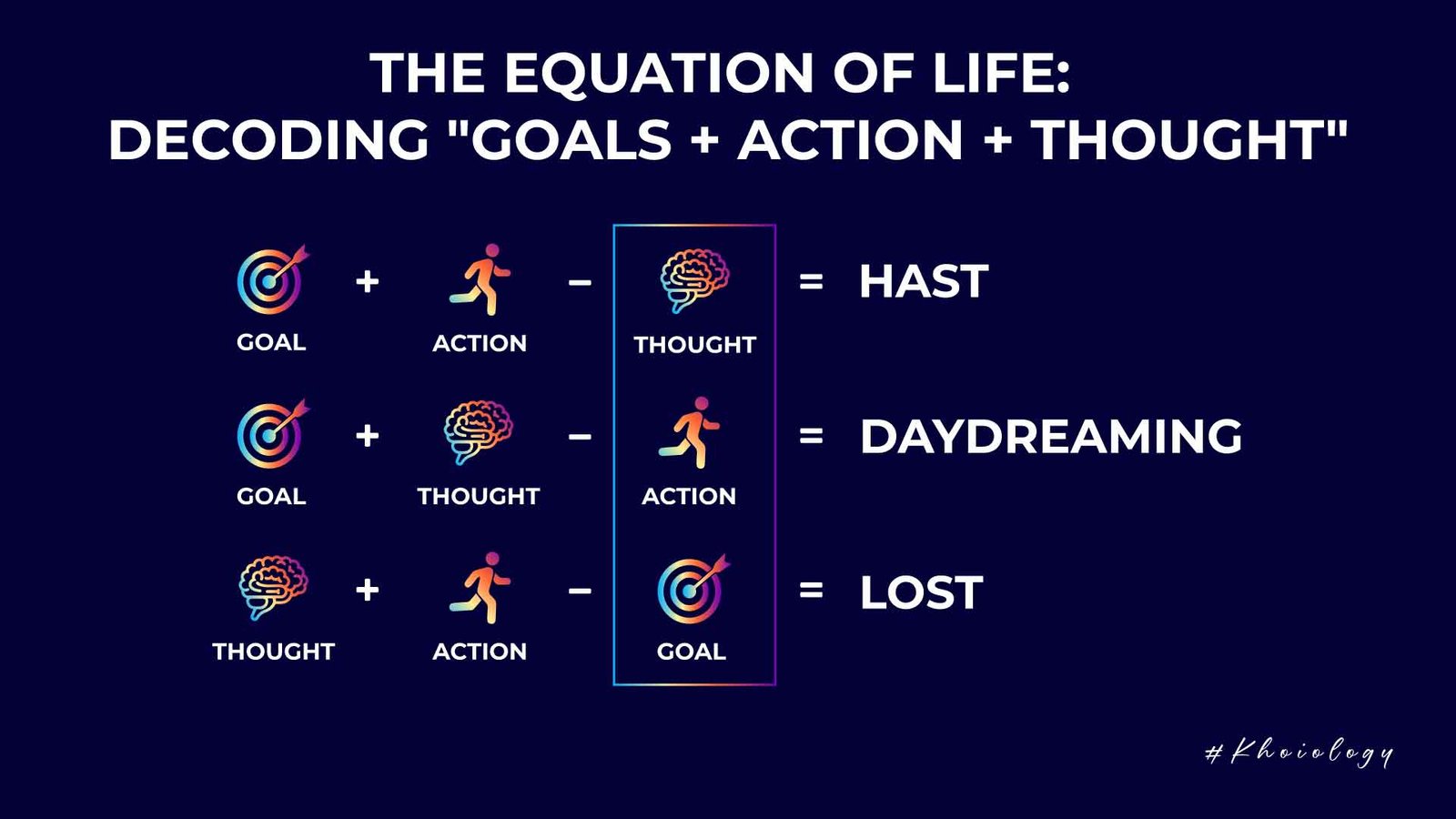
- Goal + Action – Thought = Haste
- Thought + Goal – Action = Daydreaming
- Action + Thought – Goal = Lost
These three equations perfectly describe the three biggest traps on anyone’s journey of personal development. We are busy, we are thoughtful, we have dreams, but why does a true sense of “achievement” feel so elusive?
And this poses the biggest question of all:
So: Goal + Action + Thought = ??
In this article, from the personal perspective of someone who has spent years wrestling with all three of these states, I want to dive deep with you to analyze this “three-legged stool” and find the solution to the final equation.
1. Identifying the 3 Traps of Imbalance
Before we find the solution, we must first honestly diagnose the problem. Do you see yourself in one (or more) of the portraits below?
1.1. The Trap of Haste: The “Moth” Rushing Into Work
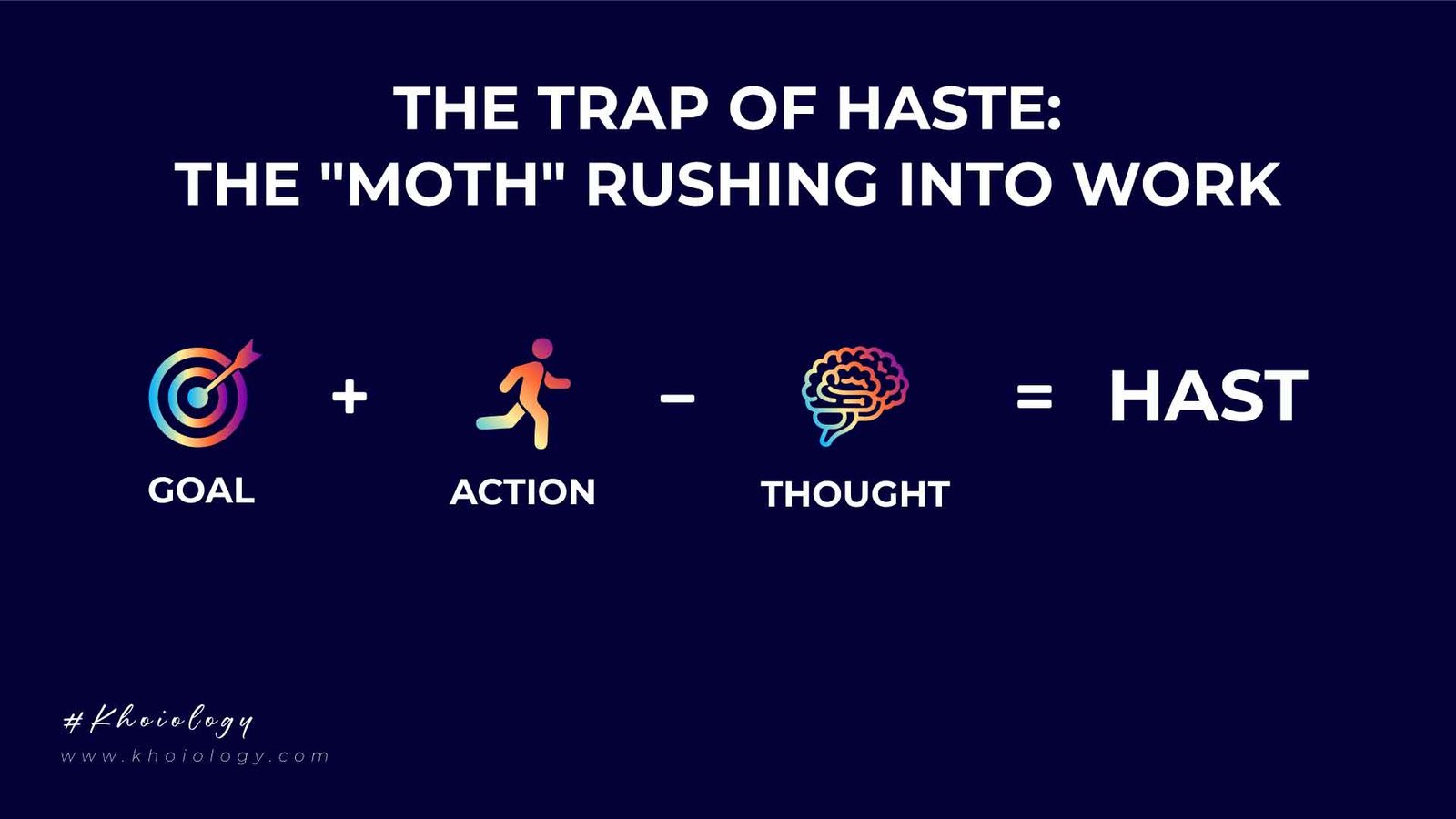
This is the portrait of the person who “works hard, not smart.” They have a clear goal (e.g., “earn $100,000”) and they take immediate action (e.g., “jump into 3-4 jobs at once, working all hours”).
What they lack is “thought”—that is, they lack strategy, optimization, and reflection.
- Symptoms: Always busy, burnt out, feeling like a “slave to work.” They are running a marathon without a map, just sprinting in the direction they think is the finish line.
- Consequence: The results are not commensurate with the effort. They might reach the goal, but at a cost that is too high (health, relationships) and with no ability to repeat that success systematically. They are stuck in “busy work” instead of “deep work.”
1.2. The Trap of Daydreaming: The “Armchair Philosopher”
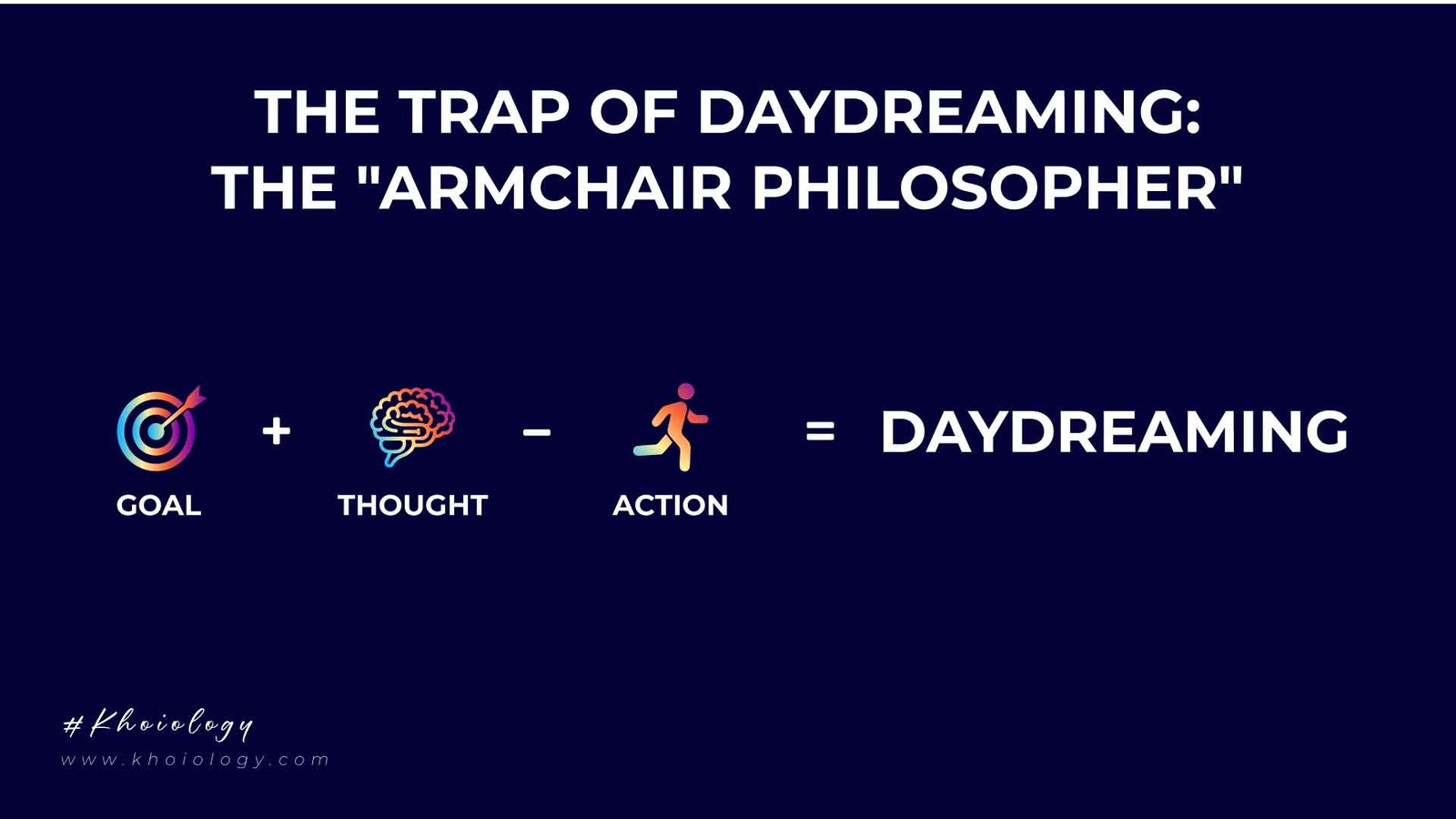
This is the sweetest trap, and perhaps the most common in our information age. We have a goal (e.g., “write a book”) and we think about it a lot (outlining, cover design, imagining the launch day).
But we lack “action.” We never actually write Chapter 1, Page 1.
- Symptoms: They are the “eternal planners.” They read 50 books on how to write a book, join 10 workshops on writing skills, but their Word file remains a blank page. The fear of failure, perfectionism, and procrastination are their closest companions.
- Consequence: Their lives are filled with “potential” that is never realized. They live in a world of “what ifs” and “if onlys.” They are the ones with the best ideas in the room, but with no products to their name.
1.3. The Trap of Being Lost: The “Hamster on the Wheel”
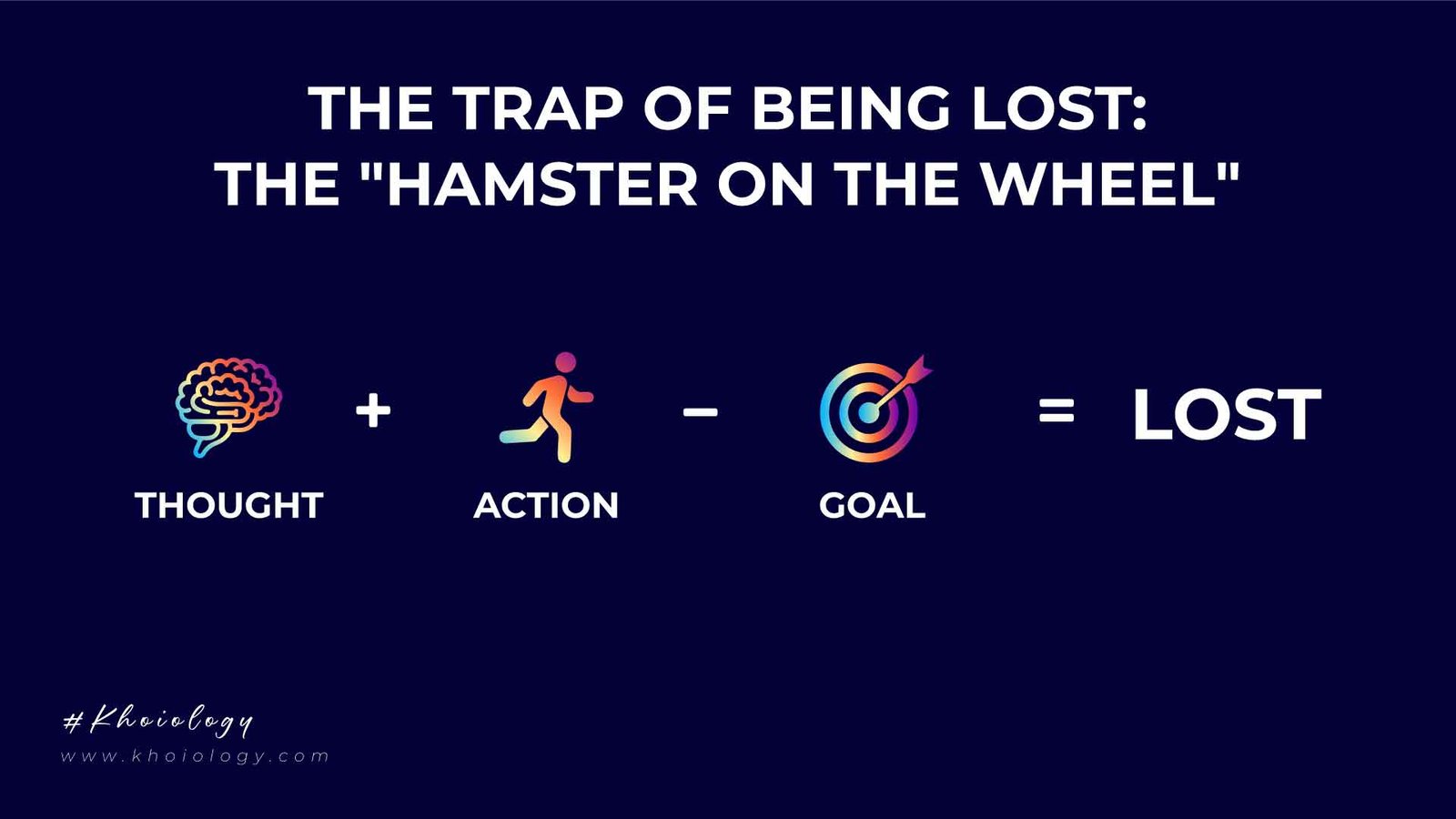
This is the most subtle and difficult trap to recognize. It often happens to highly skilled people, experts in their fields.
They act very effectively (e.g., completing every task assigned to them perfectly) and they think very thoroughly (e.g., optimizing workflows, improving techniques).
But they lack a “goal”—a “Why” that is big enough.
- Symptoms: They are a high-performance machine, working with extreme efficiency… but for what? They feel empty, aimless. They advance in their careers only to ask themselves, “Is this what I really want?”
- Consequence: They are running on a hamster wheel. The faster the wheel spins, the more tired and disoriented they feel. They are winning small “battles” every day but are losing the biggest “war”: the search for meaning in their lives.
2. The Solution to the Final Equation
If Haste, Daydreaming, and Being Lost are three “deficient” states of a stool, what do we get when we finally put all three legs on the ground?
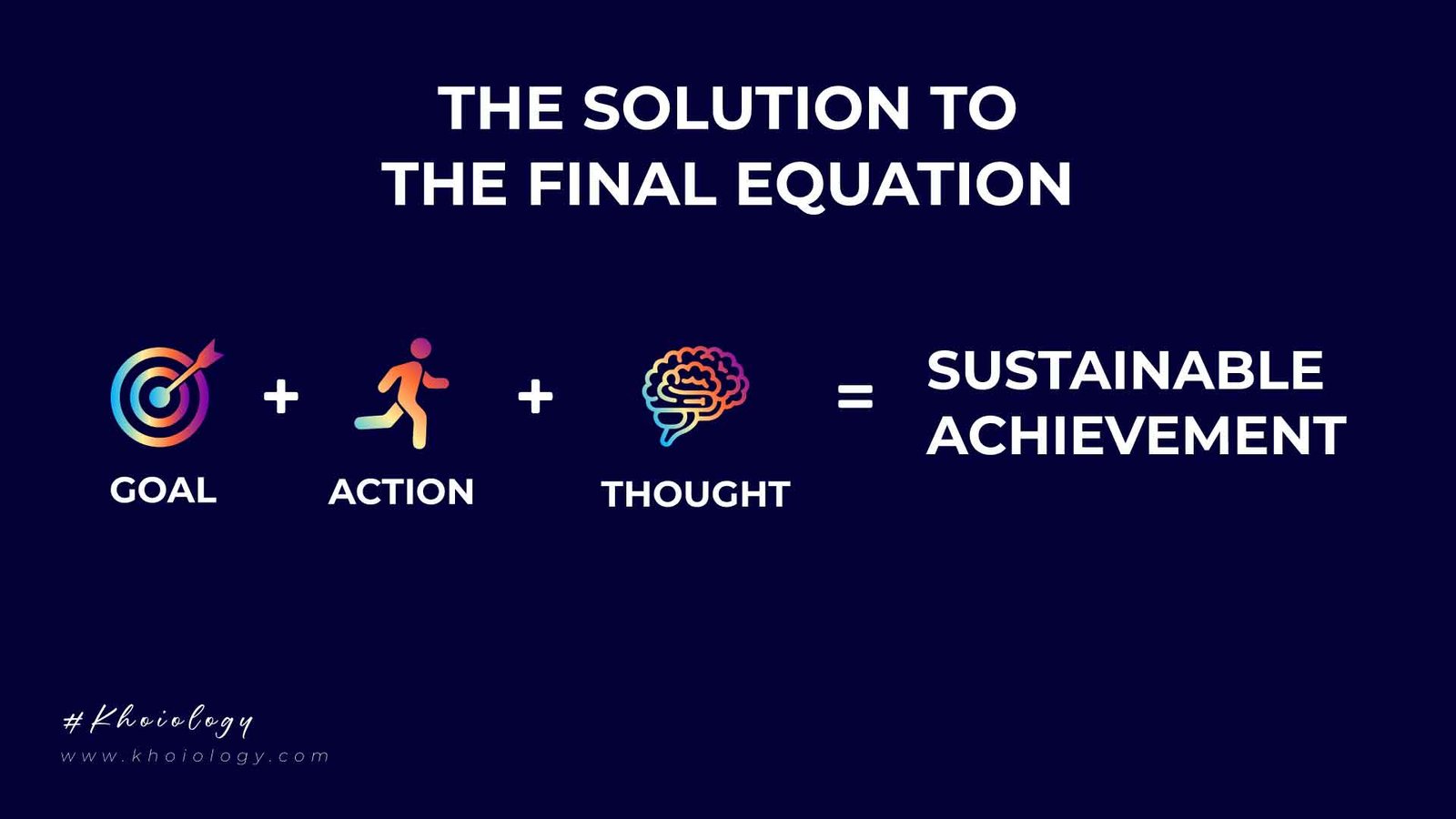
In my opinion, the answer isn’t simply “Success.” Success can sometimes be a one-time event. The answer must be Sustainable Achievement—the ability to create value meaningfully, systematically, and repeatedly, which in turn brings a sense of fulfillment.
These three elements don’t just add up; they multiply each other’s power.
2.1. GOAL: The Lighthouse (The “WHY”)
The goal is the starting point, the compass, your lighthouse. It’s not just “What” you want, but more importantly, “Why” you want it.
- A goal without a “Why” is easily abandoned when difficulties arise.
- A goal with a strong enough “Why” becomes the fuel to get you through any failure.
Without a Goal, your Action and Thought are just meaningless activities, like a machine operating in the dark. The Goal is what turns on the light, giving all your actions and thoughts a direction.
2.2. THOUGHT: The Navigator (The “HOW”)
If the Goal is the destination, Thought is the map, the strategy, the charting of the course. This is where you answer the “How.”
- Thought is planning: Breaking a large goal into small, manageable tasks.
- Thought is optimization: How to get to the destination faster, more efficiently, and with fewer resources? (This is what the “Hasty” person skips).
- Thought is reflection: Looking back on what has been done, what worked, and what didn’t. This is the “review” and course-correction process.
Without Thought, your Action becomes chaotic. You will take detours, waste energy, and easily run into dead ends.
2.3. ACTION: The Ship (The “WHAT”)
This is the decisive factor. You can have the brightest lighthouse (Goal) and the most detailed map (Thought), but if you never launch the ship and raise the sails, you will remain on the shore forever.
- Action is discipline: Doing what needs to be done, even when you don’t feel like it.
- Action is courage: Accepting risk, facing failure, and getting back up to do it again. (This is what the “Daydreamer” lacks).
- Action is the engine: It generates real-world data for “Thought” to analyze. You cannot optimize something that doesn’t exist. Action produces results, good or bad, for you to adjust.
3. The Invisible “Glue” of the Equation
Is it enough to just have these three elements?
Through years of observation and personal experience, I believe there is a fourth, invisible element that acts as a “glue” to bind these three: Coordination, or Dynamic Balance.
You cannot just “Think” in January, “Act” in February, and “Check your Goal” in March.
Fulfillment comes from your ability to continuously coordinate all three:
- You Act every day, but you take 10 minutes at the end of the day to Think (reflect).
- You Think to plan your week, but you always check it against your main Goal (the “Why”) to ensure the plan is on the right track.
- When the Goal seems too distant, you use small Actions to regain momentum, and you use Thought to adjust the goal to be more realistic (or find a new path).
This is a dance, not a rigid mathematical formula. The Hasty person only knows Action. The Daydreamer only knows Thought. The Lost person has forgotten the Goal.
The person who achieves sustainable achievement is the one who knows when to Act, when to pause to Think, and never takes their eyes off the Goal.
Conclusion: Where Are You on Your Journey?
Let’s return to the three original equations. They are not judgments, but powerful diagnostic tools.
Ask yourself right now:
- Are you being Hasty because you lack the quiet moments to think and optimize?
- Are you Daydreaming in the safety of your plans, forgetting that only “action” creates results?
- Or are you Lost on a high-performance hamster wheel, having forgotten why you started?
The solution to the equation Goal + Action + Thought is not a number, but a state: A state of balance, fulfillment, and sustainable achievement.
Take a look at your own “equation.” Which “variable” are you missing?
